
By Graham Thomas
Like film directors, boccia referees operate best in the background—rarely noticed, yet absolutely essential.
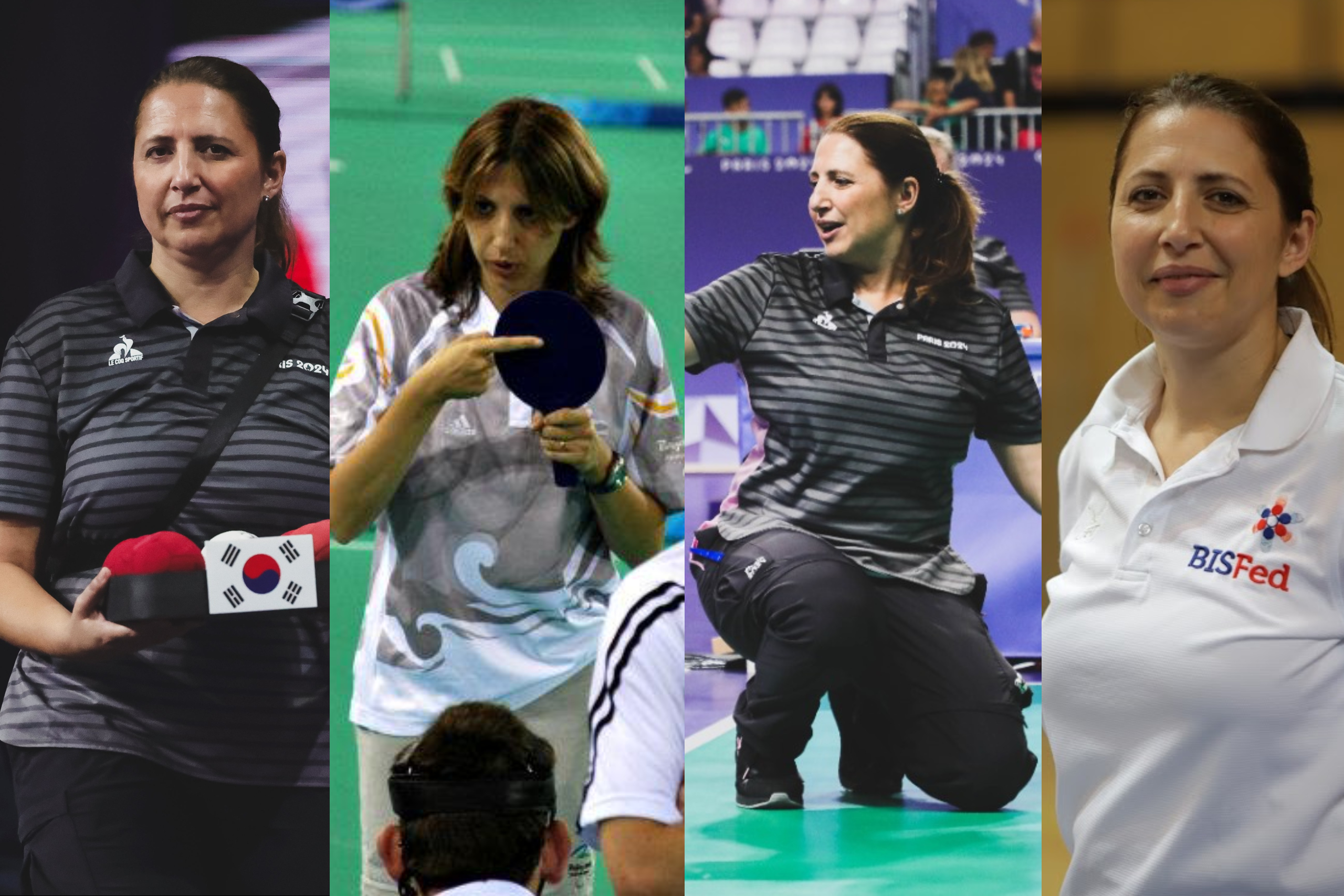
As the sport prepares for the World Boccia Championships in Seoul this August, few people are better placed to explain their role than Sandra Monteiro, the event’s head referee and one of the most experienced officials in the game.
For Sandra, refereeing is not simply about enforcing the rules. It is more about preparation, communication and trust—qualities that underpin both the selection of officials and their performance on court.
It’s also about smiling . . . a lot.
A global selection with a human touch
The process of choosing referees for a World Championships begins long before the opening ceremony. A list of nominated international referees is drawn up, taking into account experience, performance and regional representation. From there, invitations are issued—but selection is only the first step.
“After we have invited referees, we start contacting them to make sure that they have the updated rules, making sure that all the clarification they need, we can provide them beforehand,” Sandra explains.
Preparation is meticulous. Referees are briefed on rule updates, logistics and expectations well in advance, ensuring they arrive confident and focused.
As head referee, Sandra – who is from Portugal – has a role that extends far beyond selection. She oversees scheduling, coordinates with organisers, and acts as the ultimate point of support during matches.
Her philosophy is simple: remove uncertainty so referees can perform at their best.
“If they are not sure, they can just call me, that’s why I’m here. My attitude is: don’t worry, we’ll solve it.”
The invisible presence
Despite their importance, referees in boccia aim to go unnoticed and like top officials in many sports, Sandra believes that is the hallmark of excellence.
“We are there to help. We are not police agents that are laying down laws.”
In her view, the referee’s job is to facilitate the game, not dominate it.
“Players are the important elements… we are there just to help, and talk calmly, explain whatever is needed just to keep them growing as competitors, developing the sport and playing.”
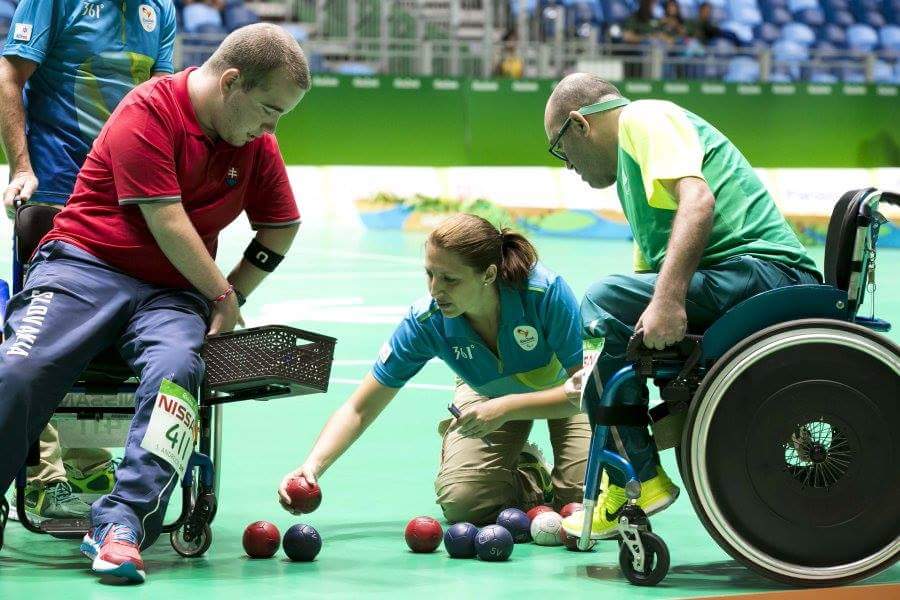
This approach is particularly significant in boccia, a sport where athletes may have complex communication needs. Referees must adapt, listen and respond with empathy.
“Usually, what I say is that we are able to communicate with everyone, we just have to find a way,” says Sandra.
The making of a referee
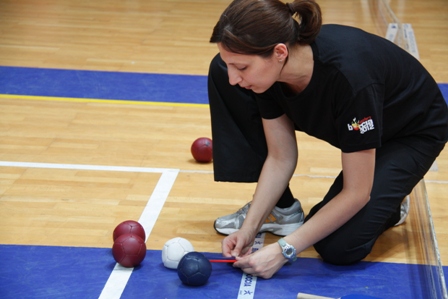
Sandra – who works in educational training – began her own journey into the sport by chance. At 18, she volunteered as a timer in her hometown of Porto, accompanying her younger sister to a local event. Within months, she was asked to referee.
“I went with my sister and some friends, and we really enjoyed all the environments, everything… Then in just a few months, they asked me to start refereeing.”
From those early steps, she progressed through regional and national levels before qualifying internationally in 2002. More than three decades later, she has officiated at four Paralympic Games and countless major tournaments.
“It has been an adventure… something very exciting.”
Despite her experience, Sandra is quick to stress that refereeing is not about perfection.
“First of all, it’s about being humble, understanding that we don’t know everything… knowing that sometimes, I fail!”
Instead, she highlights a combination of humility, confidence and teamwork as the foundation of good officiating.
“We must trust our team, we must trust what we are doing and show that we want the rules to be accomplished. But we are also there to help.”
Even small gestures matter. A smile, she says, can defuse tension and build trust with players when there are medals and titles on the line after years of striving.
“I usually tell my referees to smile a lot… then the players, they relax a little.”
Challenges and growth
Refereeing standards in boccia have improved significantly in recent years, with greater consistency and professionalism. But challenges remain—particularly because most officials are volunteers balancing the sport with full-time jobs.
Opportunities also vary widely between countries. While some nations host regular competitions, others offer limited chances for referees to gain experience.
“I know that there are countries where they have only one or two tournaments per year… that’s a limited opportunity to gain a little bit of experience,” concedes Sandra.
For aspiring referees, her advice is straightforward: get involved, stay committed and embrace opportunities.
“If you want to develop… you need to practice, you need some help and to be available for your own tournaments… but the moment you start showing that you are a good referee you will not need so much help to grow as an official, I think you will do it naturally.”
More than a role
Even for the World Championship’s top ref, things can go wrong. Sandra admits she once got into an awkward situation over the timing of an end which left an athlete feeling disappointed with her verdict.
“I was counting down the seconds and we got to zero, so the ball could not be released. But the player did not agree that we had actually reached zero, so it was a little awkward.
“In those situations, it is important to stay calm, to not feel guilty, but to try to find a way to explain and be respectful.”
Any occasional friction, she says, can usually be resolved because the boccia world is a community she describes as “like family” – – enabling an atmosphere among referees, players and coaches, built on shared experiences and mutual respect.
“It seems like a family… we don’t see each other for a long time and then we meet, then we are on court and we are referee, players, coaches… but that feeling… it’s my world.”
The sport has also offered her something less tangible but equally valuable: balance.
A teacher by profession, she sees boccia as a welcome contrast to daily life.
“It’s something that makes me relax, perhaps because I’m so used to it that it also now feels relaxing.”
Looking ahead to Seoul
As the World Championships approach, Sandra is optimistic—not just about the event, but about the continued growth of boccia.
“I feel that it’s going to be something huge this year. The sport is growing, reaching new places, and gaining new audiences. It’s in a good place and the World Championships will show that.”
Her role may keep her largely out of the spotlight, but her influence will be felt across every court in Seoul.
And if everything goes to plan, she—and her fellow referees—will hardly be noticed at all, even when they are smiling.
World Boccia Championships, Seoul, August 2026 – Officials list:
Technical Director – Edwig Lamberechts
Assistant Technical Director – Gustavo Alvarim
Head Referee – Sandra Monteiro
Assistant Head Referee – Man Yuk (David) Leung
International Referees: Lisa Hanssens, Foo Leong Wong, Chikako Okada, Sweenie Lin Tien, Scott Martin, Shin Jeong-Gil, Ronny Van Assche, Richard Evans, Beatriz Castedo, Pedro Fernandes, Anne-Dorte Andersen, Martina Kincesova, Jose Javier Garcia Moya, Teresa Calverol, Antonio Javier Echevarrias, Carlos Da Silva Oliveira, Elizabeth Albano, Marie Hebert, Marco Macias, Lorena Venegas Vera
The countries represented are: Belgium, Portugal, Hong Kong, Australia, Malaysia, Japan, Chinese Taipei, New Zealand, Korea, Great Britain, Spain, Denmark, Slovakia, Argentina, Brazil, Canada, Mexico, Chile