

By Graham Thomas and Jungin Bae
Indonesia’s rise to the top of the medal table was the headline act, but the bigger story from the Seoul 2026 World Boccia Championships was the way the old order was put under sustained pressure.
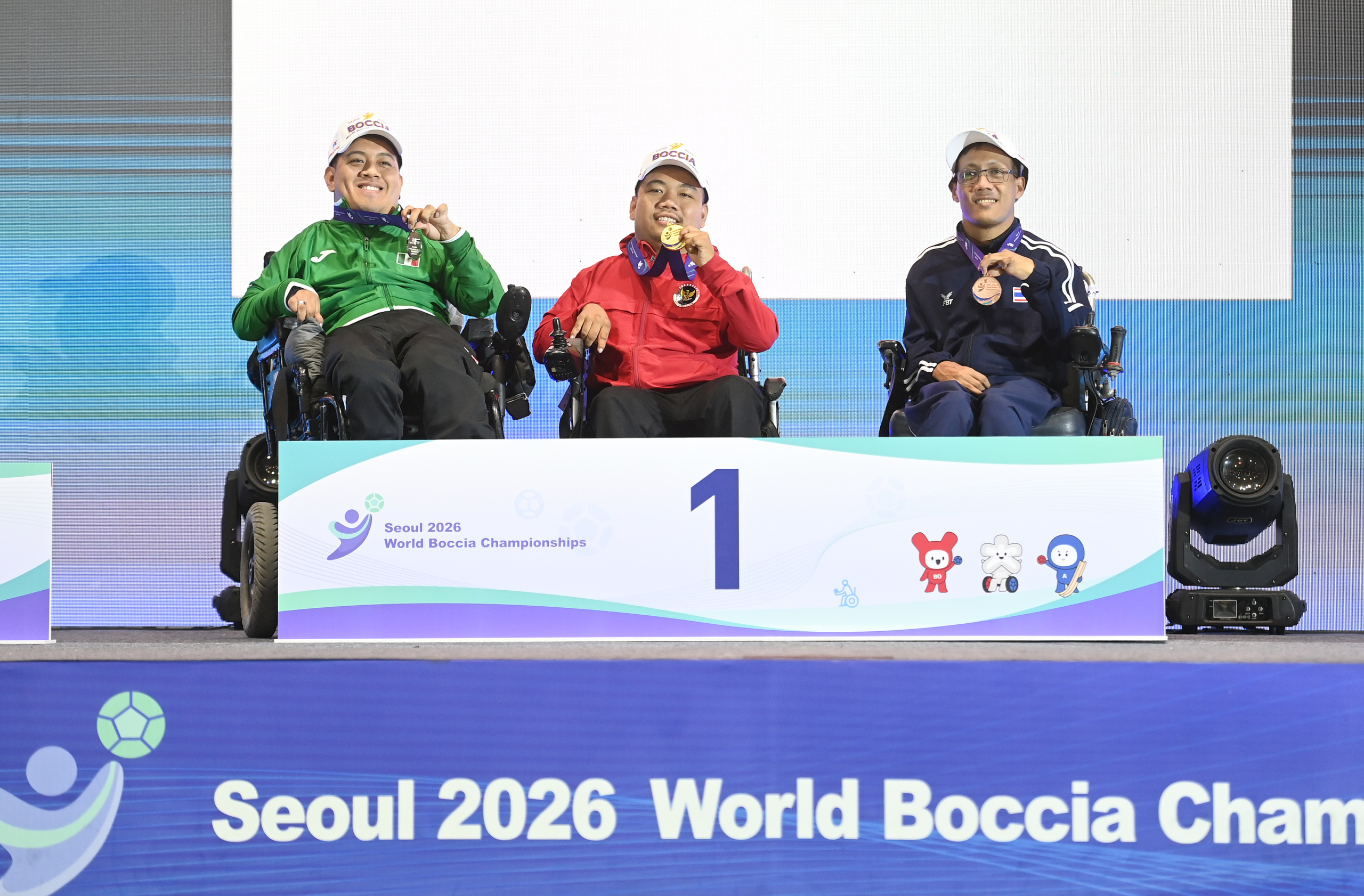
The formidable Indonesians finished with three golds and one silver medal, taking the BC1 men’s and women’s titles and the BC1/2 team crown.
Thailand were next with two golds and two bronzes, while Hong Kong topped the overall medal count with five. In all, 16 nations won at least one medal across the 11 events.
It was a striking outcome for a sport that has traditionally been dominated by a relatively small group of countries.
Indonesia’s success was not an overnight development. Their four-gold haul at the Póvoa World Cup in July had already marked them out as the nation to watch, with coach Argya Wimala pointing to daily training, improved facilities and government investment as the foundations of their rapid progress.
For the athletes themselves, however, the scale of what happened in Seoul was still difficult to absorb.
Gischa Zayana, part of Indonesia’s victorious BC1/2 team, admitted she had not expected to leave her first World Championships as gold medallists.
“First of all, we’re obviously very happy. We really didn’t expect it, because this is our team’s first World Championship, and thankfully we were blessed with the victory,” she said.
Muhamad Syafa was at the heart of that transformation, following his BC1 gold in Póvoa with the world title in Seoul.
Handayani Handayani added the women’s BC1 crown and Indonesia then completed their golden treble in the BC1/2 team event.
For Zayana, the achievement was the product of more than a sudden surge in form.
“Definitely the training, as well as the support from everyone who supports the Indonesian boccia team, and, of course, the blessing of Allah,” she said when asked what had made Indonesia so strong.
That is a significant shift. Indonesia were barely established on the international scene eight years ago. They are now world champions in three events and look increasingly capable of staying there.
And Zayana is already looking beyond the celebrations in Seoul.
With the 2028 Paralympic Games in Los Angeles now the next major target, her ambition is straightforward.
“To become better and achieve better results,” she said.
Thailand, meanwhile, demonstrated that the established powers are not disappearing. Worawut Saengampa backed up his 2024 Paralympic gold by claiming the BC2 men’s world title while Ladamanee Kla-Han took BC3 women’s gold.
Saengampa remains one of the sport’s outstanding figures, but Thailand’s four-medal haul could not match Indonesia’s impact at the top of the standings.
Hong Kong produced perhaps the most impressive performance in terms of depth. They won five medals, more than any other country, including gold for Hiu Lam Yeung in BC2 women and the BC4 women silver and bronze. Their two silvers and two bronzes underlined the strength running through their squad.
That was an especially strong response after Hong Kong left the Montreal World Cup earlier in the year without a medal. Montreal had been dominated by Japan and South Korea, who both finished with seven medals, while Mexico also produced a major surprise by winning the BC1/2 team event.
In Seoul, Mexico won two medals – Eduardo Sanchez Reyes taking silver in BC1 men and then backing that up as part of Mexico’s bronze-winning BC1/2 Team.
But South America also provided arguably the outstanding individual story of the World Championships with the emergence of the brilliant Brazillian teenager, Jose Antonio Santos.
The 19-year-old made a spectacular impact in Seoul – winning gold in BC4 Male and regularly having Brazilian supporters on their feet with the astonishing accuracy and power of his shots.
Great Britain’s Stephen McGuire had arrived in Korea as the world number one and the reigning Paralympic champion in BC4, having already established himself as the player everyone wanted to beat.
McGuire was denied in the individual tournament but he duly delivered when he teamed up with another incredible teenage talent – 18-year-old Sophie Newnham – to add the BC4 Pairs gold to his individual Paralympic title.
But there was no runaway European domination. Singapore claimed BC3 Pairs gold, Portugal and Greece took silver medals, China reached the podium and Mexico returned home with medals from both the individual and team competitions.
Singapore’s success was particularly noteworthy. Their victory in the BC3 Pairs confirmed the country’s rapid emergence as a serious force rather than merely a source of occasional individual surprises.
That development had already been visible earlier in the season, when Singapore’s Jovin Tan – the four-time former Paralympic sailor – won his first World Cup gold in BC1 men.
Japan and South Korea, who had set the pace in Montreal, were less dominant in Seoul, although both remained among the medal winners. South Korea’s Yejin Choi took silver in BC3 women, while Japan added success in the pairs competition.
For the hosts, that was probably a slightly frustrating outcome. South Korea entered their home championships with genuine medal hopes across the classifications and some of the world’s leading players, but did not turn home advantage into overall supremacy.
The individual results were equally revealing.
The outstanding Daniel Michel retained his BC3 men’s gold for Australia, Hiu Lam Yeung lifted the BC2 women’s title for Hong Kong, and the emergence of several less-established medal contenders all pointed in the same direction.
The medals are spreading.
That may be the most important conclusion to come out of Seoul.
World Boccia had identified before the championships that the tournament would bring together established champions and emerging forces, with the competitive landscape becoming increasingly difficult to predict. The final results went some way towards proving the point.
The traditional giants remain firmly in the picture. Thailand, Great Britain, Portugal, South Korea, Japan, Brazil and Hong Kong retain substantial international strength.
But Indonesia have moved to the top of the new order.
The Seoul championships therefore represented another step towards a genuinely global boccia landscape, where success is no longer concentrated among the same handful of nations.
The message from Seoul is clear: the established powers still matter, but they no longer own the podium.
